This website is updated in crip time, meaning:
“rather than bend disabled bodies and minds to meet the clock, crip time bends the clock to meet disabled bodies and minds.” - Ellen Samuels quoting Alison Kafer, in her essay ‘Six Ways of Looking at Crip Time’
Slightly faster news is available by clicking here
2026
To accompany the ‘We Year Programme’, as part of Crip Resistance II, Bec Miriam of RestFest interviewed me about making the film, and working as a chronically ill artist in crip time. You can find it on RestFest’s substack with a voiceover.
Below is an excerpt from the interview where I explain what it means to ‘year’:
‘The essay and the film are written in the present. But when in the present and chronically ill, time can expand swimmingly into the past via memory. Time can jump around rapidly, or the present and past can exist as one, fuzzy to delineate. This is especially true when significant periods of your past have been spent in fatigue, brain fog or experiencing the same symptoms in the same place over long periods of time. There is something interesting which happens with time in a relapse, arriving back to the same conditions which you have experienced in the past, your body’s memory aware of all of the times which you have felt this way. Time stretches to exist in the past and present at the same time. Like Ellen Samuels says, crip time is time travel.
I use ‘we year’ to collectively describe this experience of time. I propose using ‘year’ as a verb. Collectively we would be ‘yearing’. ‘To year’ is to experience the long, inactive (crip) time/s which chronically ill and disabled people experience. It describes months, turning into years, sick, with a reduced capacity or mobility. Further confused (or you could argue expanded) by brain fog, memory issues, and irregular sleep patterns. This is a kind of an exploded calendar expansion of the active experience of crip time. The definition of crip time which we often use is “rather than bend disabled bodies and minds to meet the clock, crip time bends the clock to meet disabled bodies and minds” (Alison Kafer 2013). Similar to crip time, which condenses and expands at the same time, ‘to year’ or ‘yearing’ can be used for the activity, or non-activity, of being ill over a long period of time, or cycles of times. One not measured by the clock, but more by the feeling of experiencing the same illness or symptoms over time - the state of sickness. For example, a year can feel like an extremely long time to be sick but it can also feel like it can pass by in the blink of an eye, especially when the years pile up, and when time is spent doing much of the same thing - resting and sleeping, time spent in the fug of being sick - years just disappear.
‘Yearing’ also includes recurring periods of time spent in relapse. With recurrences and relapses, or simply many years piling up, several years then become the ‘normal’ state. So one can also ‘year’ over multiple years. This differentiates between an illness which has an end date, one which can be ‘cured’, and one which continues and repeats, penetrating and shaping your life as a chronically ill person. If ‘to year’ and ‘yearing’ is a verb, then ‘we year’ encompasses us all, all of us with restricted capacity.
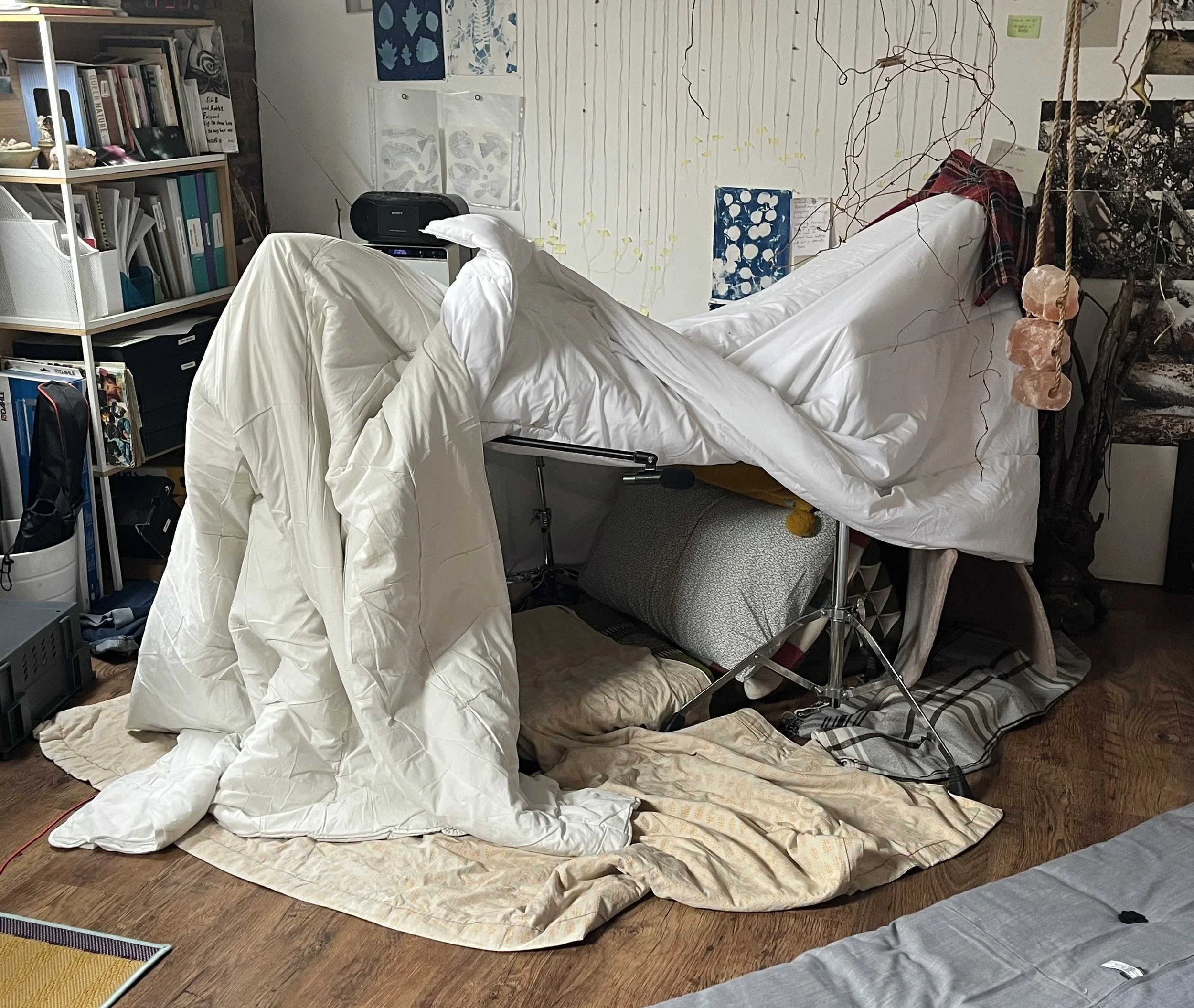
My crip home recording studio
I am SO excited to announce the first screening of my film ‘We Year’ with RestFest Film Festival!
It will screen remotely for two weeks from 15-28 June, book tickets here. Watch from bed!
RestFest is an artist-run, online community arts gathering space and virtual film & video art festival created by/for the Disabled, Deaf, Chronically ill, Neurodivergent, and/or Mad arts community worldwide.
This event is part of the larger ‘We Year Programme’, a series of interdisciplinary events and workshops inspired by and responding to the themes of the film ‘We Year’ by Sop, held by various crip and disabled friends and allies, including RestFest, The Remote Body, as well as Resting Up Collective x Ort Gallery via the Crip Resistance II programme.
… I am brimming with excitement to share that I have been working on a ‘We Year Programme’ of remote events for the chronically ill and disabled community as part of Crip Resistance II: Holding Space, Building Community - exploring further the embodied experience of ‘yearing’ indoors, and highlighting crip community support and resistance with my own dearest crip network:
Charlie Fitz from Resting Up Collective
Char Heather from The Remote Body
Bec Miriam from RestFest
and the wonderful Aaisha Akhtar, the current Artistic Lead at Ort Gallery
Additional events:
🖤 ‘Permeable Body, Porous Time: Join the We Year Writing Workshop’ with Char Heather on June 16th at 2pm UK time. Join us for discussion and writing prompts on boundaries of inside/outside and crip time. Book tickets here
🖤 A special edition of ‘Crip Film Club’ with RestFest and The Remote Body on July 19th at 6pm UK time. We will be watching Sop's ‘We Year’ film together, followed by an informal Q&A with the artist and a broader chat about the film. Book tickets here
Before the screening I will also be sharing an in depth interview about the film with Bec/RestFest and about working as an neurodivergent artist with chronic illnesses.
You can find out more about the ‘Crip Resistance II programme’ here
‘We Year’ was commissioned by Shape Arts as part of the 2024 Adam Reynolds Award programme.
Edited by Kester Davies, soundtrack by MIDDEX with original music by Two White Cranes
More about the programme:
Join Resting Up Collective (RUC)and Ort Gallery for Crip Resistance II: Holding Space, Building Community, an online programme of events exploring disabled, sick, mad, and crip modes of resistance and remote community care.
From June 2026 onwards, this interdisciplinary collaboration will feature a series of online events including creative workshops, artist talks, and film screenings. This year, the programme's focus on community building is evident in its bringing together a wider network of crip collectives, organisations, and artists.
The programme’s print publication, which documents and expands on its themes, will also launch this year. 20% of the event and publication proceeds will support Disabled People Against Cuts.
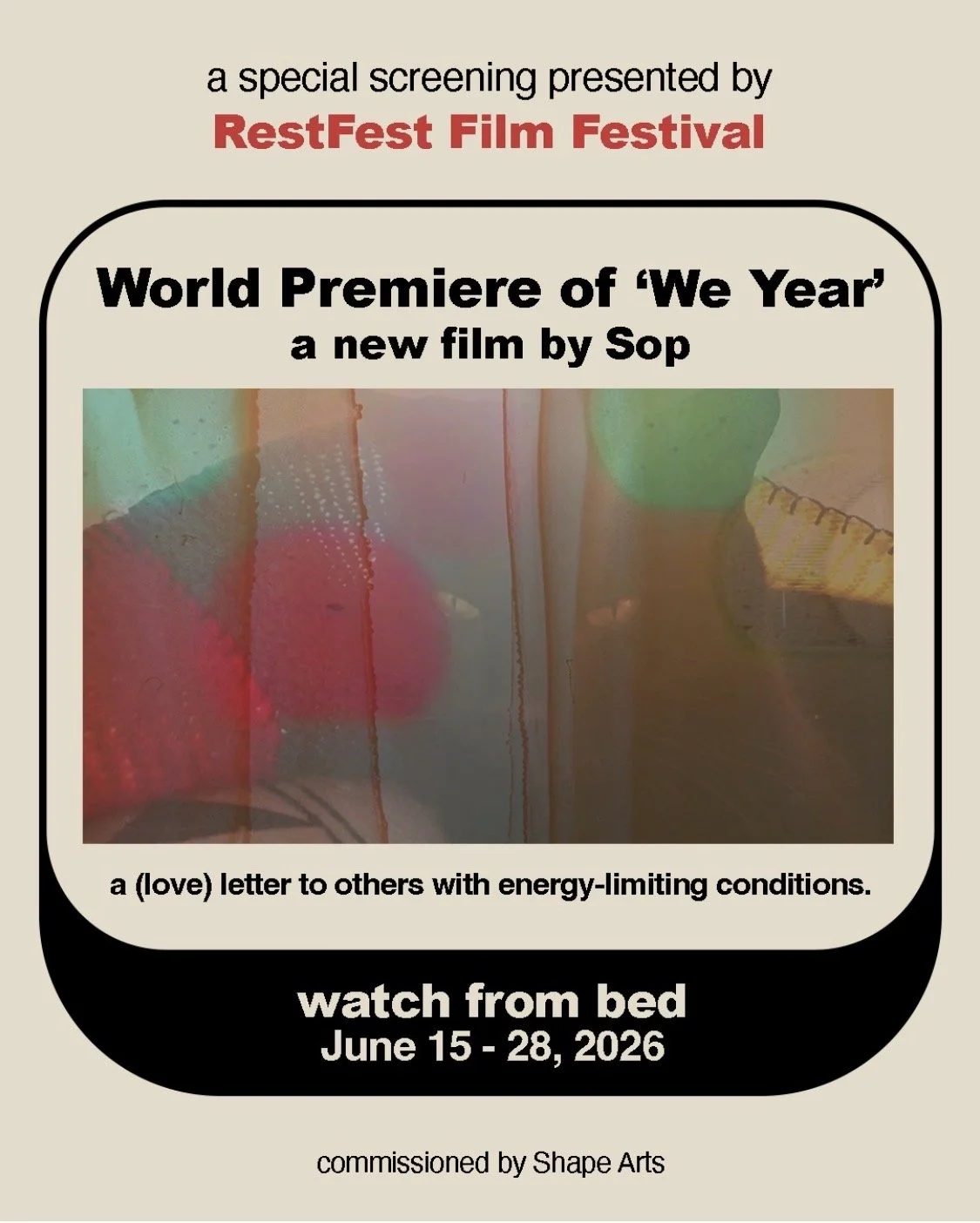
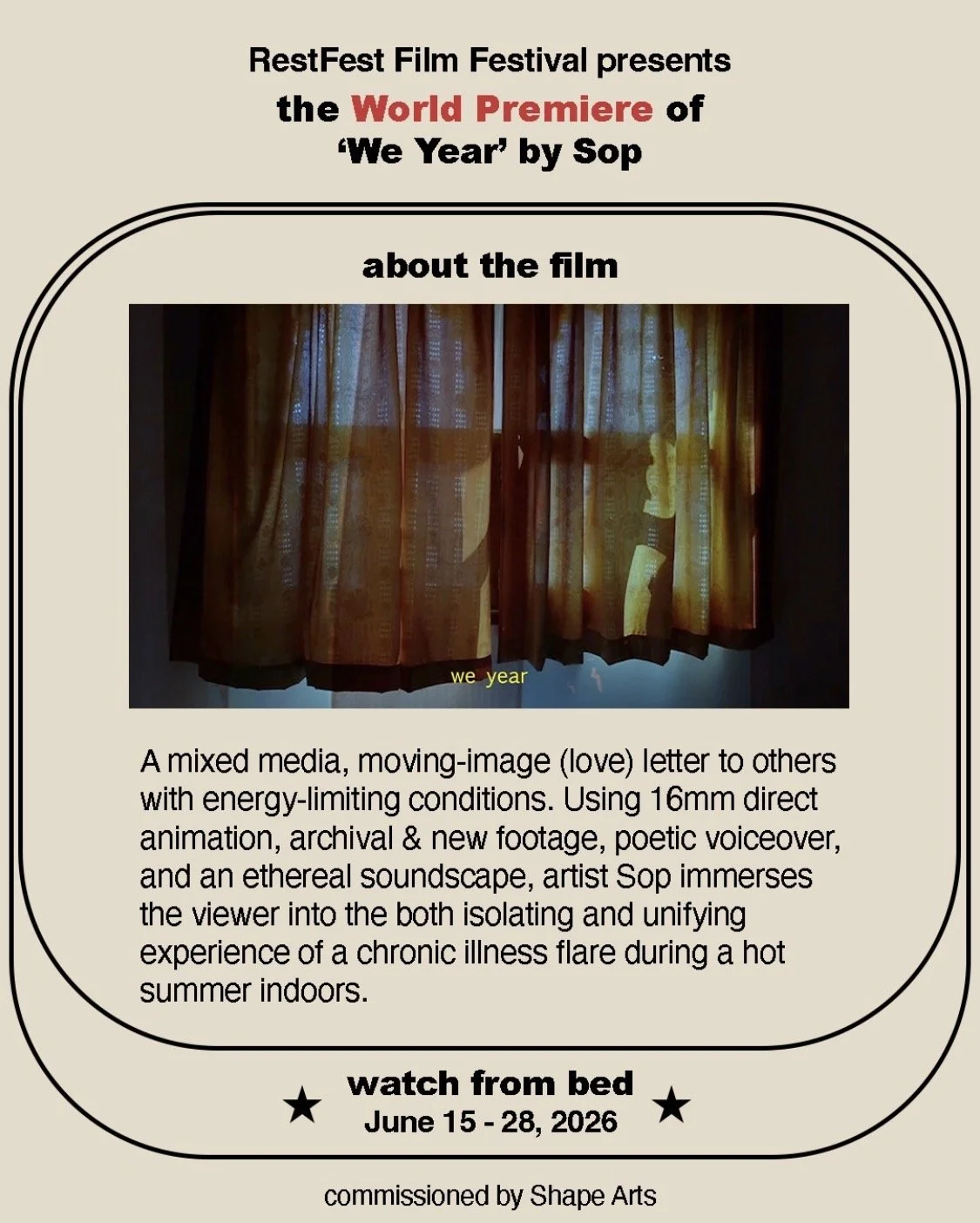
The brilliant Sophie J Williamson wrote about my new short film ‘We Year’ in February’s issue of Art Monthly in her essay ‘Sick at Art’, along with work by El Morgan and Shannon Finnegan. Here, she tackles the fragile continuence of working (and not working) whilst chronically ill, and a wavering visiblity in the relentless onward charge of art industry. Essential reading to understand how we, the chronically ill, vibrate-in-stasis, alongside each other. You can read the full piece here
‘We Year’, 2025 was commissioned by Shape Arts as part of the Adam Reynolds Award.
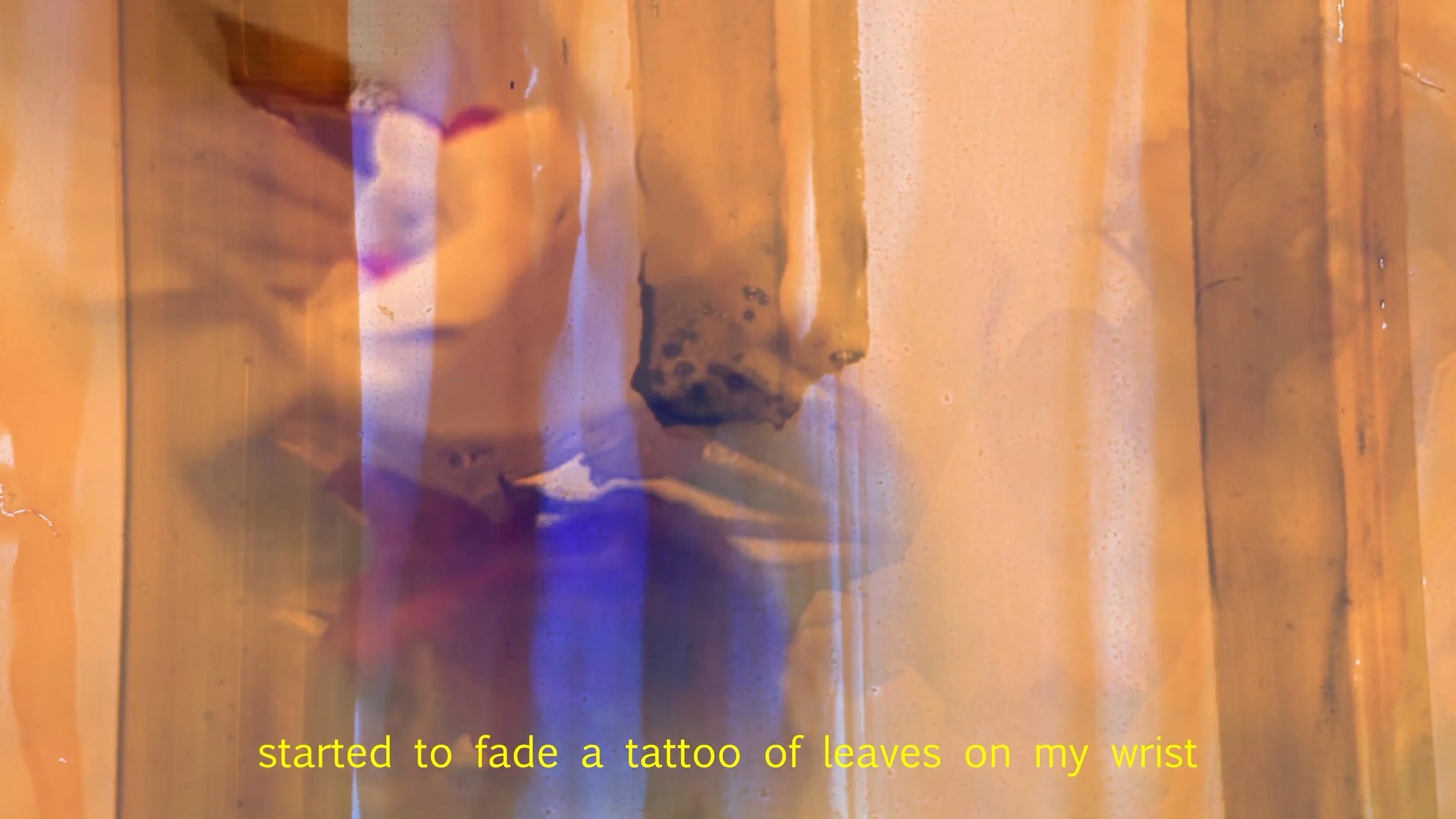
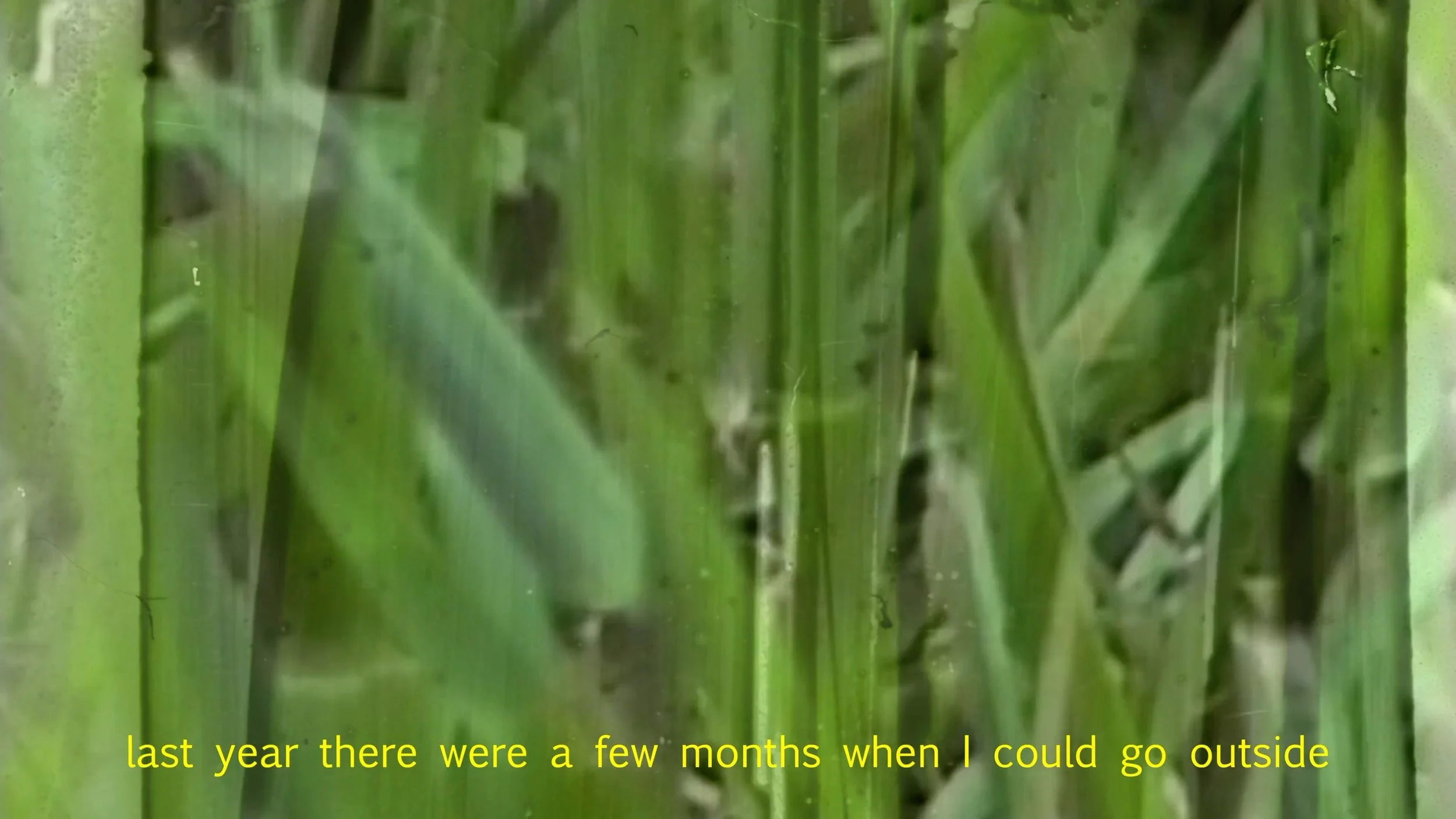
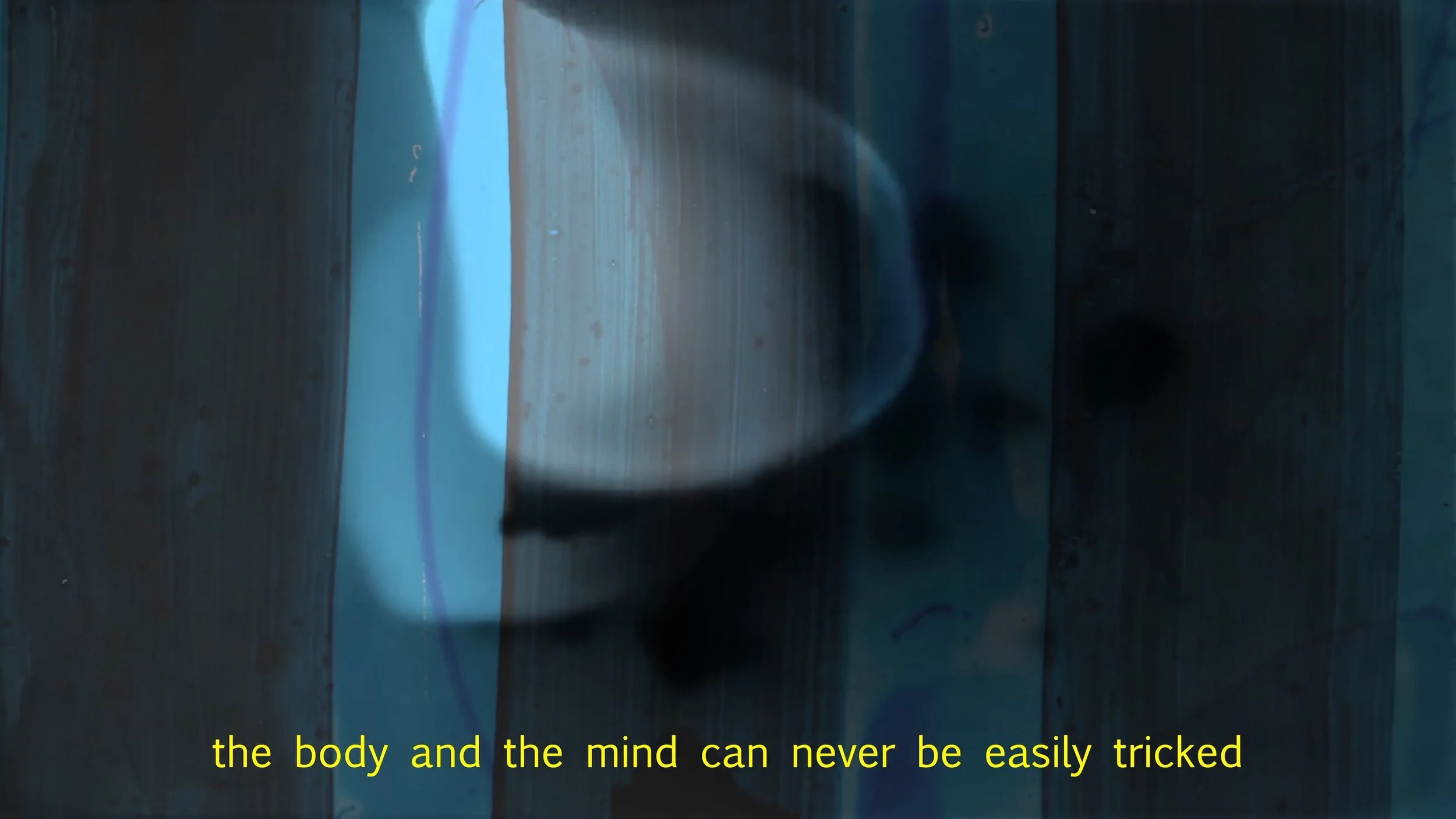
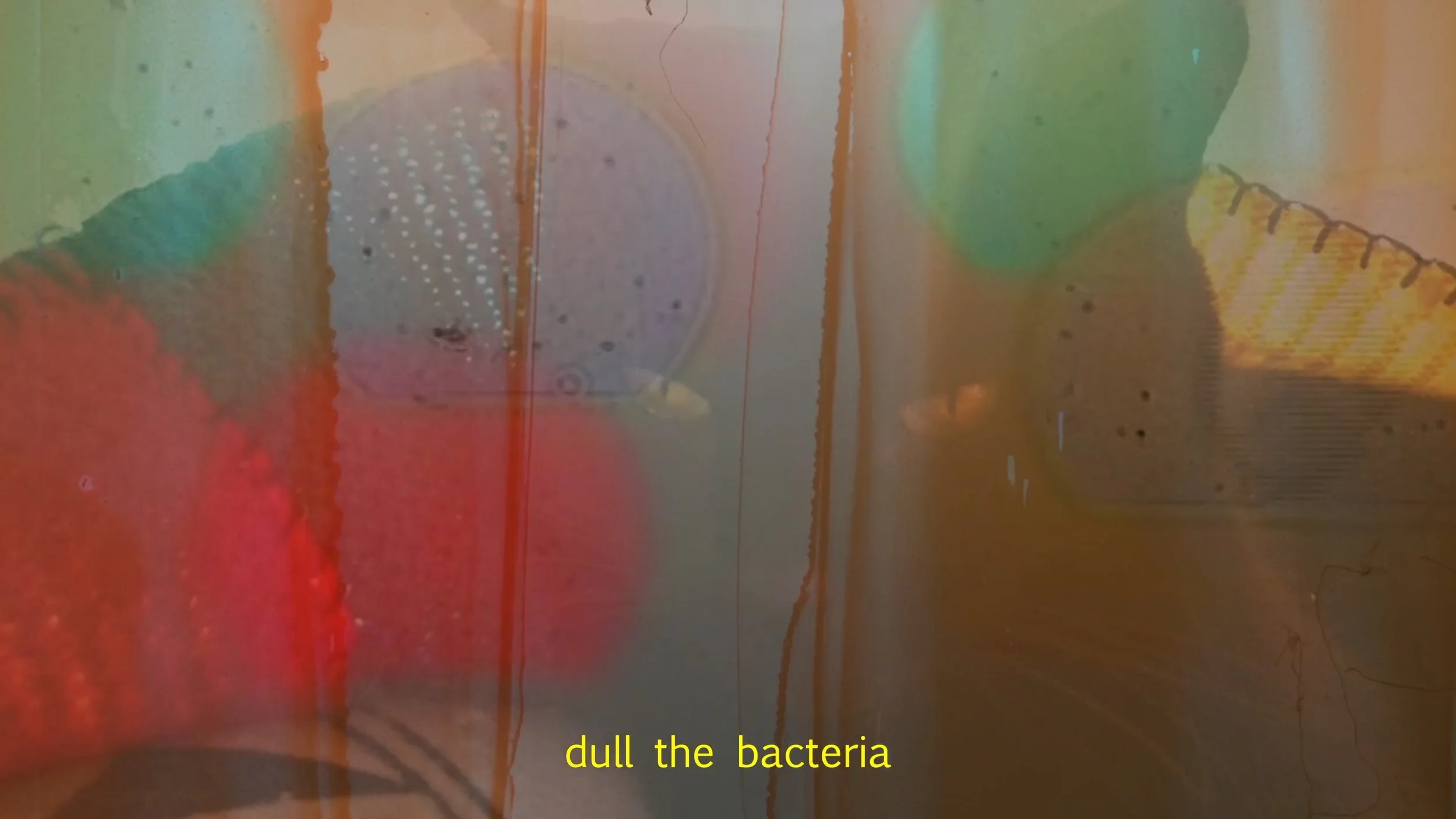
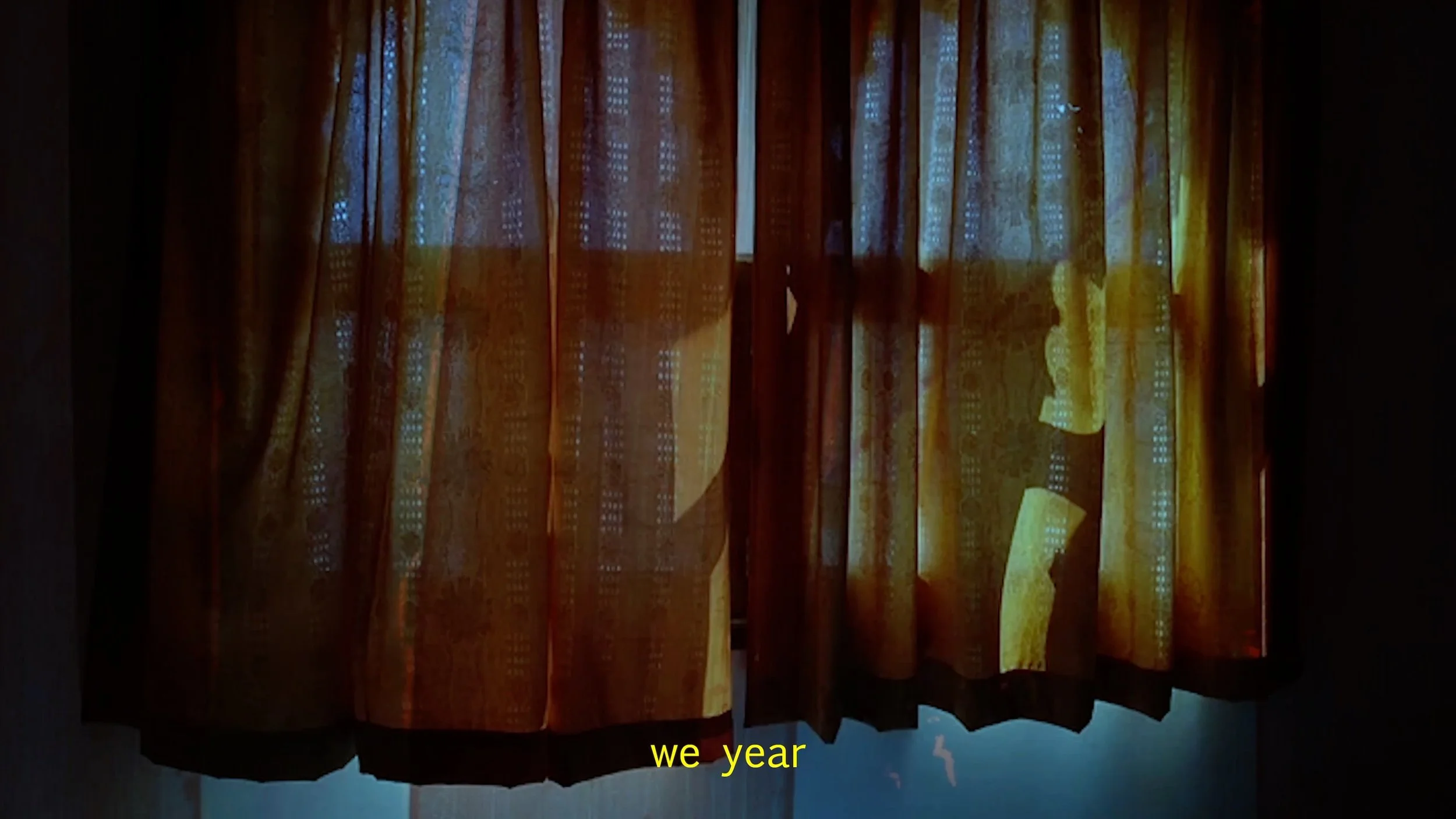
Below is an extract about my film, along with some stills.
2025


I am completely in love with the publication made by Katie Spragg for The Fragmented Landscape exhibition at Ruup & Form
I wrote a poem for a new photography project called ‘KISSES FROM THE SUN’, of which two photographs are included, alongside a conversation between the participants in the show, and really rich and interesting work and writing by all involved.
You can order a copy here and a link to the online accessible text from the publication is here.
24 pages. Limited edition riso print. Publication design by work-form.
Printed by Pagemasters. Conceived and curated by Katie Spragg

I took a walk in the woods, 2021. Installation images courtesy of Ruup & Form.

I took a walk in the woods, 2021. Installation images courtesy of Ruup & Form.
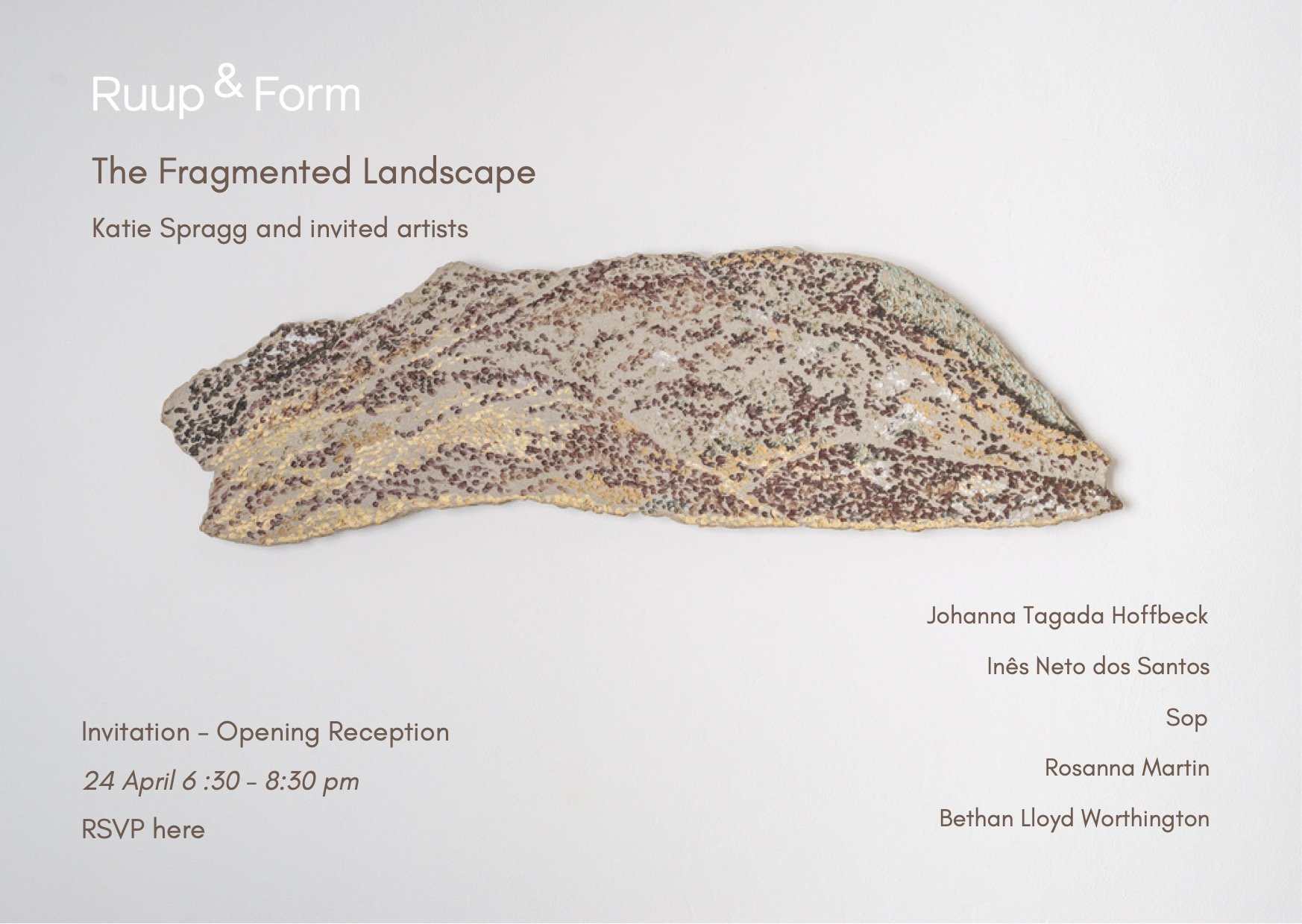
Katie Spragg has generously opened out her exhibition to create The Fragmented Landscape at Ruup & Form inviting myself, Johanna Tagada Hoffbeck, Rosanna Martin, Inês Neto dos Santos and Bethan Lloyd Worthington to integrate and generate work and conversation as a supporting, tangental fragment to her recent works.
Various methods of communicating via workshop, group note/mapping and the old what’s app over the past few months, enabled us to merge our current thinking and research in a myriad of fragmented ways which will result in the exhibition and a risograph publication.
I will be showing prints of ‘I took a walk in the woods’, and some new photographs and a poem from a project ‘KISSES FROM THE SUN’ in the publication made for the exhibition.
25th April - 24th May
Ruup & Form, 7 Tilney Court, Old Street, EC1V 9BQ
From Ruup & Form: ‘The Fragmented Landscape’ invites the viewers to explore the diverse plant life and environments that have shaped Katie Spragg’s practice over the past eight years. The exhibition brings together contrasting landscapes and ecosystems, prompting reflection on how they coexist, inform each other, and occasionally collide.
At its core, the exhibition examines the fragmented nature of memory, observation, and representation. Drawing from her work with people living with dementia, Spragg embraces the fluidity and ambiguity of nature, encouraging visitors to consider how fragmentation offers a deeper understanding of both the natural world and ourselves.
Spragg has invited five artists—Johanna Tagada Hoffbeck, Rosanna Martin, Inês Neto dos Santos, Sop, and Bethan Lloyd Worthington—to expand this dialogue. Their works explore themes of caregiving, longing, and the textures of lived experience, forming a fragmented yet interconnected landscape.’

resting up collective and ORT gallery are joining forces to present Crip Resistance: Holding Space, Building Community an online programme of events exploring disabled, sick, mad, and crip modes of resistance and remote community care.
As a member of RUC, I am very excited to be presenting my Walk/Shop - ‘Halo/Echo: A Walk Without Walking’ on 8th April for the first time remotely! The group will be intimate and materials will be sent out by post before the event, and you can book here. I look forward to ‘walking’ with you through landscapes from your own memory or dreams.
More about the programme:
From February to May 2025, this interdisciplinary collaboration will feature a series of online events including creative workshops, artist talks, live performances, and film screenings.
The programme will include a print and online publication documenting and expanding on the programme's themes. Finally, RUC will curate a book collection for Birmingham Resistance Library.
20% of the event and publication proceeds will support Gaza Sunbirds.
This programme will be running on Crip Time. As a result, we endeavour to reschedule events should any of our contributors not feel well / experience a change in capacity in the lead up to and / or on the day of the event itself.
About the Organisers:
RUC—resting up collective is an interdisciplinary group of chronically ill and disabled friends practising slowness/crip time to create, think, and interrupt neoliberal pressures and expectations on the body. We offer workshops and spaces for the crip community. We are running our second iteration of Postcards from Flaresville, a slow mail chain of care-full postcards from one resting space to another. We are slow works in progress, open to all who wish to join and help dream/organise.
Ort Gallery is a visual arts and poetry organisation based in Birmingham. We are on a social mission to redefine contemporary visual arts by rejecting the sector’s exclusivity, centring access and equity, and providing inclusive high quality art experiences. We support this mission with a care-centred approach (aka Warmth) and give artists, team members and participants autonomy over their projects.
Ort believes everyone should have access to high quality art experiences and aims to meet this standard by providing exhibition and professional development opportunities to artists, creatives and community members across all backgrounds.
We place Warmth at the heart of all our work. We recognise that galleries can be sites of oppression which centre and reproduce white normative and elitist ways of “being’ under the supposed guise of neutrality. We are interested in challenging this head on; whilst also committing to creating space for local artists and marginalised community groups across Birmingham and beyond to play an active role in shaping such practices, in the hopes of transforming ourselves, our city, and the wider arts ecology.
2024

Book cover: Bodies of Sound: Becoming a Feminist Ear, edited and introduced by Irene Revell and Sarah Shin. Published by Silver Press
I am beyond excited for The Den 3 to be included in this survey of feminist sound edited by Irene Revell and Sarah Shin, published by Silver Press
‘‘I am concerned with the power of sound! and what it can do to the body and the mind’ wrote composer Pauline Oliveros. In the body, histories and politics come together with sound and listening, memory and feeling. Bodies of Sound: Becoming a Feminist Ear offers a resonant exploration of feminist sonic cultures and radical listening in over fifty contributions. In this book of echoes, a variety of forms – from essays to text scores to art, fiction and memoir – speak across gender, ways of knowing, witnessing, sounding and speaking, translation, displacement, violence and peace.’
With contributions from:
Sara Ahmed, Ximena Alarcón, Svetlana Alexievich, Ain Bailey & Frances Morgan, Anna Barham, Xenia Benivolski, Leanne Betasamosake Simpson & Kite, Elena Biserna, Karen Barad & Black Quantum Futurism, Anne Bourne, Daniela Cascella, Theresa Hak Kyung Cha, Maria Chávez, Don Mee Choi, Carson Cole Arthur, Petero Kalulé & AM Kanngieser, Lindsay Cooper, Julia Eckhardt, Lucia Farinati & Claudia Firth, Ella Finer, Annie Goh, Louise Gray, Christina Hazboun, Johanna Hedva, Sarah Hennies, Tomoko Hojo, IONE, Lee Ingleton, Hannah Catherine Jones, Christine Sun Kim, Nat Lall, Cathy Lane, Jeanne Lee & Lona Foote, Marysia Lewandowska, Annea Lockwood & Jennifer Lucy Allan, Cannach MacBride, Elaine Mitchener & Hannah Kendall, Alison O'Daniel, Naomi Okabe, Pauline Oliveros, Daphne Oram, Gascia Ouzounian, Holly Pester, Roy Claire Potter, Anna Raimondo, Tara Rodgers, Aura Satz & Barbara London, Shortwave Collective, Sisters of the Order of Celestial Nephology, Sop, Syma Tariq, Marie Thompson, Trinh T. Minh-ha & Stoffel Debuysere, Salomé Voegelin

Book Cover: Botanical Architecture: Plants, Buildings and Us by Paul Dobraszczyk, published by Reaktion Books
Portable Den is included in this fascinating publication out in October 2024 - Botanical Architecture: Plants, Buildings and Us by Paul Dobraszczyk, published by Reaktion Books.
‘A provocative and original take on the relationship between ecology and architecture.
When we look at trees, we see a form of natural architecture, and yet we have seemingly always exploited trees to make new buildings of our own. While a tree creates its own structure, we generally destroy other things to build, with increasingly disastrous consequences.
Looking closely at how elements of plants – seeds, roots, trunks, branches, leaves, flowers and canopies – relate to buildings, this book asks what might be required to design with plants and become more attuned to vegetal life in our structures. It also proposes that we build as much for plants as for ourselves, understanding that our lives are always totally dependent on theirs. Botanical Architecture offers a provocative and original take on the relationship between ecology and architecture.’

Poster for RestFest film festival, August 15th - 22nd, 2024
I was really thrilled to be included in the inaugural RestFest Festival this August showing Pneuma (Revisited), 2022 alongside many other wonderful disabled artists and filmmakers in August.
In their own words: RestFest is a community gathering space and film & video art festival created by/for the Disabled, Deaf, chronically ill, neurodivergent, mentally ill, and/or mad community.
The RestFest team worked endlessly to make the festival truly accessible, with a lively and wide-ranging series of additional events and mixers, and I would highly recommend keeping an eye on this festival for future years!
I took a walk in the woods, 2021
Join me on March 9th at Whitechapel Gallery for my Walk/Shop - ‘Halo/Echo: A Walk Without Walking’ for the launch of ‘Documents of Contemporary Art: Walking’ book (Whitechapel Gallery/MIT Press, Ed. Tom Jeffreys). Book here
‘The world and the living are nothing but a halo, an echo of the relation that binds them together.’ Emanuele Coccia (The Life of Plants: A Metaphysics of Mixture, 2018)
‘…what changes if the walk is virtual or fictional?’ Tom Jeffreys (Introduction to Walking: Documents of Contemporary Art, 2024)
Prompted by their experience of visiting landscapes in recurring dreams, Sop invites participants on an artist-led ‘walk/shop’ – a ‘cripped’ walk where you don’t have to move.
Using sound, somatic exercises and herbal tools, and prioritising comfort and autonomy, the group will be guided into a liminal state in which to take a walk through a landscape from their own memory or from their own dreams.
Reflecting on your experience, you will be invited to note down features, sensations, emotions and any narrative from your ‘walk’, and share this with your fellow walkers, if desired. In doing so we can collectivise the individual experiences, travelling between our dreamed or remembered landscapes.
Following the walk/shop, at 2pm Tom Jeffreys will be in conversation with artists Jade de Montserrat and Amanda Thomson to discuss the political power of walking.
Thank you to Lindsay Corstorphine for the sound production for the workshop

Book cover: Jade Montserrat and Webb-Ellis, Peat (2015) film still. Courtesy of the artists
I am honoured to be included in the forthcoming Documents of Contemporary Art: Walking book published by Whitechapel Gallery and the MIT Press, edited by Tom Jeffreys. Publication date: March 2024.
It includes The Den 2 (transcript) which was the only chapter of the three part audio piece (The Den 1 - 3) which hadn’t had a public showing beyond a brief one night on the internet! It is the chapter which I found the hardest, documenting a time where lockdown had ended, but not for the people still shielding, and not knowing when that would end. Strangely, the stand out walking line is not about a physical walk: ‘I stay in bed and go for a walk on Google maps’.
The transcripts are always to be shown alongside the audio, and stand alone as a poetic arrangement on the page, the script sitting alongside a detailed description of the sounds heard. I am so happy it will be breathing in these pages.
2023
In July, alongside Charlie Fitz, Alexandrina Hemsley, Alec Finlay, and Dre Spisto I showed ‘Pneuma (Revisited)’ and joined Charlie and Dre in conversation at the British Museum for their event in collaboration with Shape Arts: ‘Shards: Contemporary representations of disability’.

Pneuma (Revisited), 2022
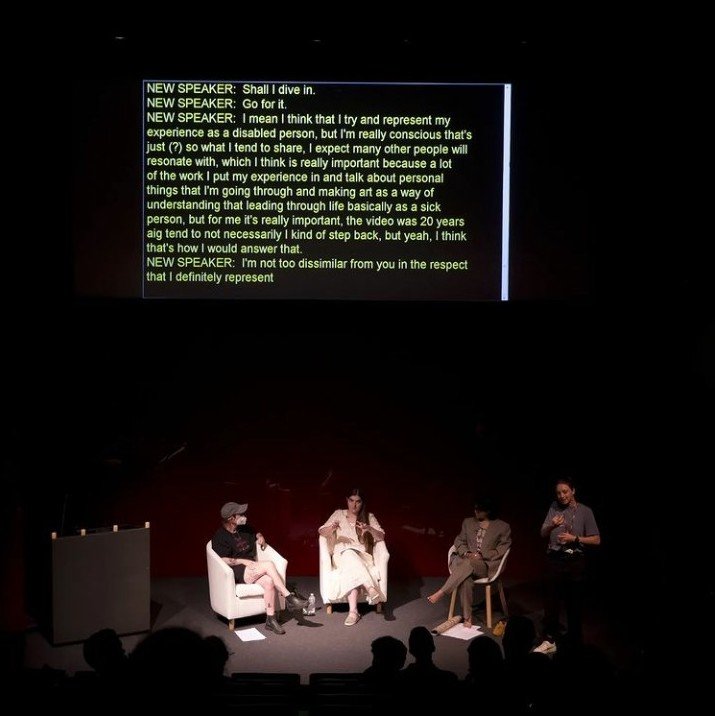
Sop, Charlie and Dre in conversation for Shards: Contemporary representations of disability, British Museum/Shape Arts
2022
I am delighted that stills from ‘turn your cloak for fairy folks live in old oaks’ and textual slivers from Den 1 - 3 are included in CONCRETA 19, TIEMPO PROFUNDO/DEEP TIME editorial by Bárbara Rodríguez Muñoz.
Concreta 19 (Spring 2022) deploys a renewed literacy of time and conjures up subsequent epistemic shifts by resituating us in the chain to which we have always belonged: deep time, dark time, crip time, vegetable time, cyclical time. How this profound time is articulated in contemporary artistic, curatorial and philosophical practices is what this issue addresses. It has the edition of Bárbara Rodríguez Muñoz and the collaboration of Catherine Malabou, Petra Feriancová, Grace L. Dillon, Laura Vallés Vílchez, Maria Ptqk, Irene Kopelman, Sop, Miguel Ángel Martínez, Tavia Nyong'o, Institute for Postnatural Studies, Jorge Van den Eynde, Kim Hyesoon, Rachel Pimm, and Graham Cunnington.
Concreta 19 (primavera 2022) despliega una renovada alfabetización del tiempo y conjura sobre subsecuentes cambios epistémicos al resituarnos en la cadena a la que siempre pertenecimos: tiempo profundo, tiempo oscuro, tiempo crip, tiempo vegetal, tiempo cíclico. Cómo se articula dicho tiempo profundo en las practicas artísticas, curatoriales y filosóficas contemporáneas es aquello a lo que atiende este número. Cuenta con la edición de Bárbara Rodríguez Muñoz y la colaboración de Catherine Malabou, Petra Feriancová, Grace L. Dillon, Laura Vallés Vílchez, Maria Ptqk, Irene Kopelman, Sop, Miguel Ángel Martínez, Tavia Nyong’o, Institute for Postnatural Studies, Jorge Van den Eynde, Kim Hyesoon, Rachel Pimm y Graham Cunnington.
Order here


Pages from Concreta 19, Tiempo Profundo/Deep Time
I have been invited to the 2022 Shape Open In The Mirror along with twenty-five international disabled and non-disabled artists.
‘In culture, mirrors are used to symbolise truth. It is also said that art is a mirror turned on society, reflecting the issues and mood of the current moment. In this way, the artist interrogates and sheds light, revealing things that might otherwise be disguised or hidden.
For disabled people, however, too often what they find in the cultural mirror is distorted, filled with representations that are not only untrue, but harmful, damaging to individuals and communities.
This exhibition treats the subject of disability differently, using the lens of lived experience. Taking place in an age when mirrors are everywhere, even in our phones, it challenges the processes and assumptions that forge our ideas of who we are, and how we are shown.’
For the exhibition I revisit an old video made on Hi-8 and an essay I wrote about the work which was commissioned by Towner Eastbourne in 2021. 'Pneuma (revisited)' uses a film 'Pneuma' made in 2000, originally shown silently on a loop, with the addition of excerpts from the essay about the work in 2021 - a year when we became more than usually concerned with the idea of ‘the breath’. I became chronically ill around halfway between these two works, and this new film can now be seen in a different context, beyond the playful, whimsical gesture for which it was originally made. This new version comments on invisible illness, grief, disappearing in plain sight, isolation and dissociation, common daily states for someone living with chronic illness.

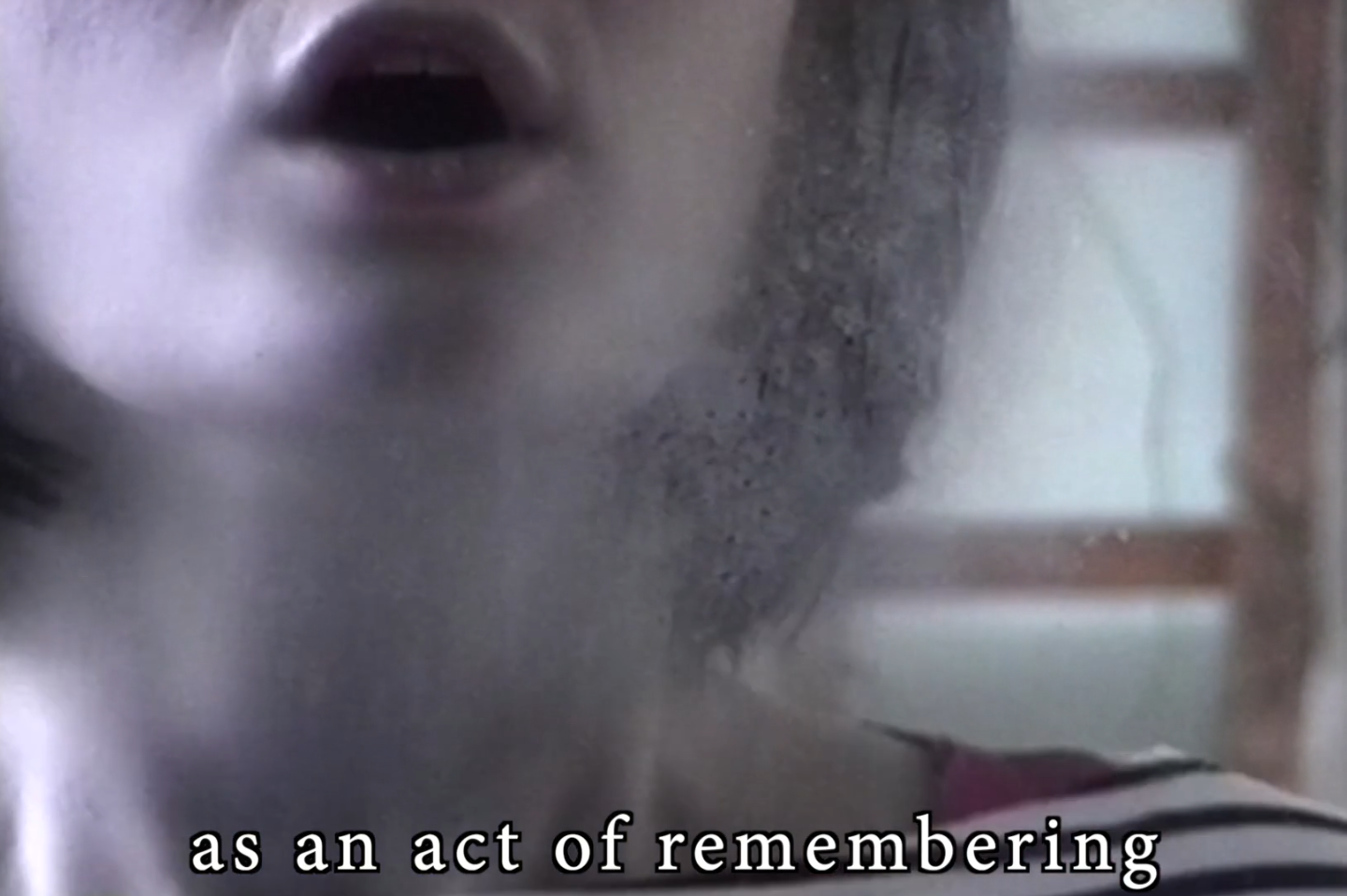
Pneuma (Revisited), 2022
Rooted Beings Exhibition at Wellcome Collection, 24 March 2022 - 29 August 2022.
Three new works commissioned by Wellcome Collection are included in this group show: ‘The Den 3’, the final part of the trilogy, a sculpture ‘Portable Den’ and a new film ‘turn your cloak for fairy folks live in old oaks’. ‘‘Rooted Beings’ invites you to embark on a meditative reflection on the world of plants and fungi. The exhibition considers what we might learn from plant behaviour, and the impacts of colonial expeditions on the exploitation of natural resources and indigenous knowledges.

Portable Den, 2021

The Den 3, 2021 and Portable Den, 2021

turn your cloak for fairy folks live in old oaks, 2021. All photography by Wellcome Collection, 2022
I have been matched with Sam Metz as an EOP Member as part of The Exchange 2. The Exchange 2 is the second iteration of a project connecting artists and creative practitioners across the UK. Bridging the gap created by limited movement and opportunity to network The Exchange aims to create new exchanges and friendships between artists that wouldn’t otherwise be able to connect. This open-ended process has no limits or boundaries but is simply framed by the invitation to begin a conversation.
The Den parts 1 and 2 broadcast on Radiophrenia in February. Radiophrenia is a temporary art radio station – a two-week exploration into current trends in sound and transmission arts.
2021
The Den, installation at Wellcome Collection, 18 May 2021 - 13 June 2021. Artist Sop explores alternative strategies for self-care during the Covid-19 pandemic through a series of meditative sound works. Watch the curators talk here.

6.06 am, 6.09 am, 2020 and The Den 1, 2020

The Den 1, 2020. All photography by Wellcome Collection, 2021
Rhiannon Armstrong commissioned me as dmf to interpret a song for their project How to Hold, Behold, and be Held commissioned by Wellcome Collection. Listen below, and listen to all of the songs here.